The Jewish Museum Berlin (Jüdisches Museum Berlin)
It consists of two buildings. One is the old Kollegienhaus, a former courthouse, built in the 18th century. The other, a new addition specifically built for the museum, designed by world-
Daniel Libeskind. The museum opened to the public in 2001.
![]()
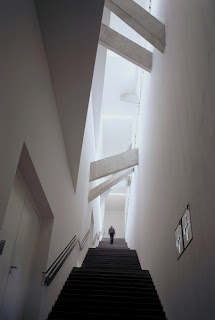
The Jewish Museum is a museum which explicitly thematises and integrates, for the first time in post-war Germany, the history of the Jews in Germany and the repercussions of the Holocaust. The museum exhibits the social, political and cultural history of Jews in Berlin from the 4th Century to the present.
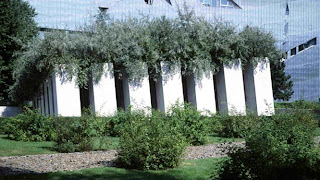
The new extension is connected to the Baroque building via underground axial roads. The longest road leads to the "Stair of Continuity" and to the Museum itself, while the second leads to the "Garden of Exile and Emigration" and the third to the dead end of the "Holocaust Void." The displacement of the spirit is made visible through the straight line of the Void which cuts the ensemble as a whole, connecting the museum exhibition spaces to each other via bridges. The Void is the impenetrable emptiness across which the absence of Berlin's Jewish citizens is made apparent to the visitor.

"There are three basic ideas that formed the foundation for the Jewish Museum design. First, the impossibility of understanding the history of Berlin without understanding the enormous intellectual, economic and cultural contribution made by the Jewish citizens of Berlin. Second, the necessity to integrate physically and spiritually the meaning of the Holocaust into the consciousness and memory of the city of Berlin. Third, that only through the acknowledgement and incorporation of this erasure and void of Jewish life in Berlin, can the history of Berlin and Europe have a human future.
"The official name of the project is the "Jewish Museum," but I have called it 'Between the Lines.' It is a project about two lines of thinking, organization and relationship. One is a straight line, but broken into many fragments; the other is a tortuous line, but continuing indefinitely.
"The third aspect of this project was my interest in the names of those persons who were deported from Berlin during the fatal years of the Holocaust. I asked for and received from Bonn two very large volumes called the 'Gedenkbuch.' They are incredibly impressive because all they contain are names, just lists and lists of names, dates of birth, dates of deportation and presumed places where these people were murdered. I looked for the names of the Berliners and where they had died - in Riga, in the Lodz ghetto, and in the concentration camps.
"The fourth aspect of the project is formed by Walter Benjamin's 'One Way Street.' This aspect is incorporated into the continuous sequence of 60 sections along the zigzag, each of which represents one of the 'Stations of the Star,' described in the text of Walter Benjamin.

"In more specific terms, the building measures more than 15,000 square meters. The entrance is through the Baroque Kollegienhaus and then into a dramatic entry Void by a stair, which descends under the existing building foundations, crisscrosses underground, and materializes itself as an independent building on the outside. The existing building is tied to the extension underground, preserving the contradictory autonomy of both the old building and the new building on the surface, while binding the two together in the depth of time and space.
"There are three underground 'roads' which programmatically have three separate stories. The first and longest road leads to the main stair, to the continuation of Berlin's history, and to the exhibition spaces in the Jewish Museum. The second road leads outdoors to the E.T.A. Hoffmann Garden and represents the exile and emigration of Jews from Germany. The third axis leads to the dead end - the Holocaust Void.
"Cutting through the form of the Jewish Museum is a Void, a straight line whose impenetrability forms the central focus around which the exhibitions are organized. In order to cross from one space of the Museum to the other, the visitors traverse sixty bridges which open into the Void space, the embodiment of absence.
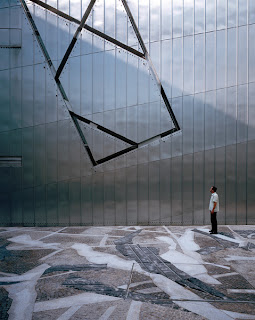
"The work is conceived as a museum for all Berliners, for all citizens. Not only those of the present, but those of the future who might find their heritage and hope in this particular place. With its special emphasis on the Jewish dimension of Berlin's history, this building gives voice to a common fate - to the contradictions of the ordered and disordered, the chosen and not chosen, the vocal and silent." Daniel Libeskind


